
Fields in Calvert County Property Tax Records
Two records sit behind every Calvert County property tax record. SDAT's assessment card carries the value, use class, owner, premises, and deed reference. The Treasurer's bill adds the levy details: tax year, bill type, charges, payments, and adjustments. Match the parcel number and year before comparing any dollar amounts.
| Field | What It Shows | Where |
|---|---|---|
| Current / base value | Assessment figures and phase-in context | Maryland SDAT card |
| Owner and premises | Name from the last recorded deed and property address | SDAT; bill repeats a dated owner snapshot |
| Parcel ID and tax year | Account being billed and the levy year | Treasurer bill |
| Bill type and charges | Annual or installment record and amounts applied | Treasurer bill |
| Payments / adjustments | Posting and account changes | Treasurer history |
| Delinquency / sale status | Unpaid account and later statutory process | Treasurer and tax-sale materials |
Maryland law assesses real property at 100% of market value. Even so, four figures stay separate: the assessed value, the taxable phase-in, the billed amount, and the consideration on the recorded deed. A tax bill is not an appraisal. It does not predict a sale price either.
Open a Calvert Real-Estate Tax Bill
The county's bill guide begins inside the payment system. Pick Real Estate, then query by street address or parcel ID. Drop any unit or suite from an address search. Type the parcel without its dash. Only the first 50 matches display. A wide street search may need a tighter account key to narrow results.
| Search field | Format | Result use |
|---|---|---|
| Record type | Choose Real Estate | Separates real property from other bills |
| Street address | No unit or suite | Finds candidate parcels; first 50 shown |
| Parcel ID | Enter without dash | Opens the exact account |
| Result row | Parcel ID, address, unit, owner | Choose the matching property |
| Bill detail | Tax year, bill type, view bill | Read payment and adjustment history |
No account is needed to view a bill. Save the parcel ID and tax year with your copy. The owner name and amount shown belong to that bill's preparation and posting dates, so they may not reflect later changes.
Calvert Tax Bills Can Trail a Recent Deed
The Treasurer states plainly that bills reflect ownership as it stood when the bill was created. A deed recorded afterward can leave the former owner on the display while SDAT and county systems catch up. GIS assessment-linked fields refresh monthly, too. So one transfer can surface at three different times.
Owner timing. Do not treat the bill's name as present title. Check SDAT's Owner Name and the most recent recorded deed.
The Treasurer sends an incorrect owner field on an assessment to SDAT, which can be reached at 443-550-6840. A phone request alone will not change the owner of record. SDAT requires the recorded deed trail before it updates the name.
Read Calvert and Twin Beaches Tax Rates Carefully
The county's FY2027 rate page lists Calvert real property at $0.967 per $100 of assessed value. Chesapeake Beach and North Beach each show a town real-property rate of $0.605 per $100. Those figures belong to that year alone. For any other year, use the live county rates page. Do not carry the numbers forward.
County and municipal charges can both appear in one account history. The assessment is still the base on which every rate is applied. Confirm the jurisdiction and tax year before comparing two parcels.
Note: A mailing ZIP or familiar town name does not establish municipal tax status; verify the parcel's jurisdiction and tax district.
Follow a Calvert County Tax Account Through Its Bill
Start with the account, open the chosen year, and only then check how SDAT's value and relief connect to the county charges. Keep prior bills apart from the current one. A payment or adjustment always belongs to one levy year.
- Open the Treasurer's Office tax-bill link and choose Real Estate.
- Search by a normalized address or the parcel ID without its dash.
- Confirm the parcel, owner snapshot, tax year, and bill type before opening the bill.
- Review payments and adjustments, then compare the SDAT assessment fields.
- If delinquent, consult the current tax-sale list and redemption information.
- Assessed value
- The state value used within Maryland's property-tax system.
- Levy or tax rate
- The rate applied for the named jurisdiction and year.
- Homestead credit or exemption
- Relief governed by its own eligibility and application rules.
- Tax lien
- A legal claim arising from unpaid property charges.
Calvert County Due Dates and Payment Posting
The county FAQ sets September 30 as the due date for annual bills. That date also applies to the first semiannual installment. December 31 brings the second installment. Mortgage companies often pay in the final week of those months. Online payments can take two business days to post.
Payment channels include cash or check at the Treasurer's Office. The office also offers a drop box and online payment. The county page listed a $2.59 eCheck convenience fee and a 3.57% card fee. Confirm current fees and posting instructions before paying.
When Calvert Property Tax Reaches Tax Sale
Calvert's annual tax sale can reach property that is two years delinquent. Qualifying water and sewer delinquencies may also be included. The county publishes sale and result material each year. A buyer gets a tax-sale certificate, not immediate title. The owner keeps a statutory redemption path.
County procedure allows six months first. After that, the certificate holder may begin foreclosure of the right of redemption. Costs, notices, court steps, payment, and later deed issues must all be read from the current official materials. The county tax-sale page explains the two-year delinquency rule and current sale resources.
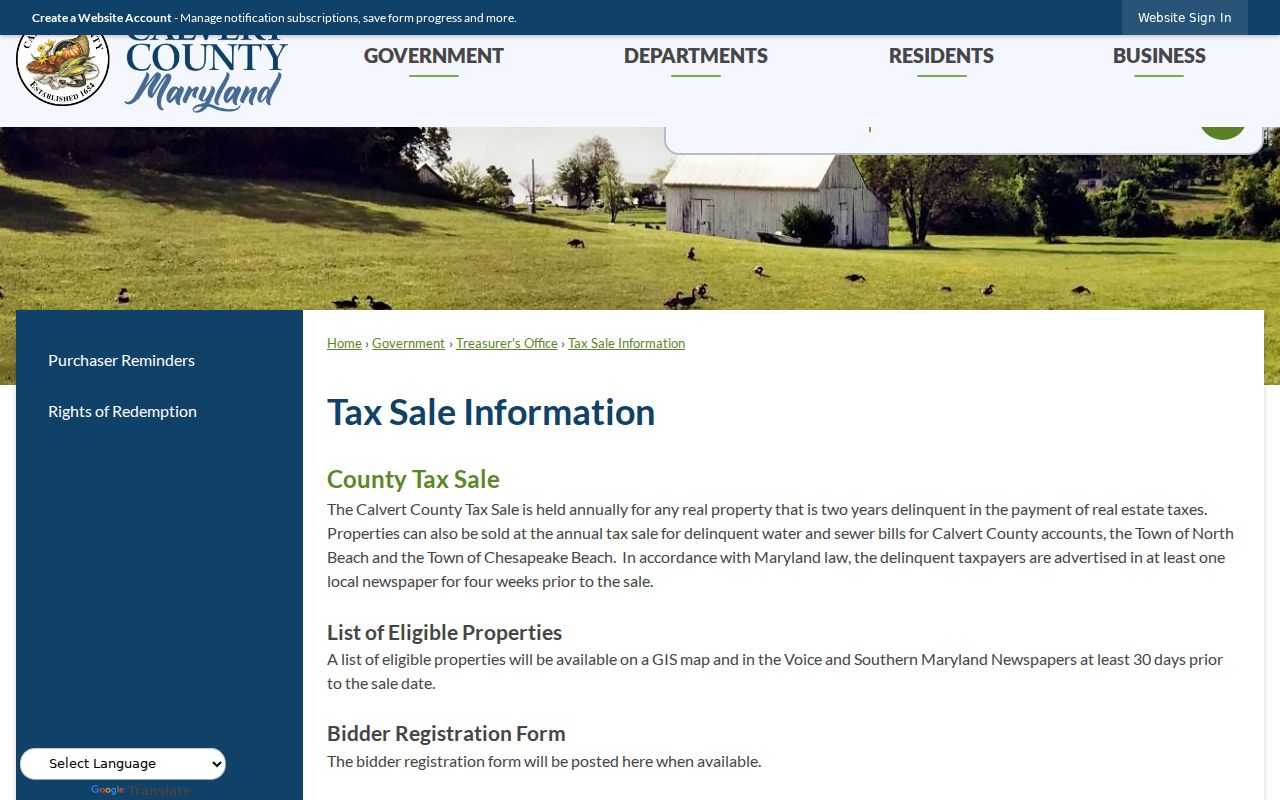
The county's own tax-sale page makes the gap clear. A certificate and a final ownership record are never the same event.
Assessment Ratios Give Calvert County Context
The FY2025 Maryland assessment-ratio survey puts Calvert's weighted ratio at 93.3%. Its residential ratio sits at 93.2%. That study compares assessments against market evidence across the county. It is not a parcel-specific reassessment. No single bill adjusts automatically because of it.
Maryland's legal assessment level has been 100% of market value since July 2001. The distinction matters. One number states the standard; the other measures observed assessment levels during a study period.
Contest a Calvert County Assessment on Time
A Maryland assessment appeal starts with the notice. The first-level appeal must be filed within 45 days. Strong evidence helps: the property worksheet, corrected characteristics, and comparable area sales. A clear explanation of the claimed error matters too. From there, an unhappy owner can move to the Property Tax Assessment Appeal Board. Under stated rules, the Maryland Tax Court comes next. Read each deadline separately, because a tax-bill inquiry does not preserve an assessment appeal.
Appeal window. File the first appeal within 45 days of the assessment notice. A call about the bill does not replace a timely appeal filing.
Use Every Calvert Tax-Record Access Channel
Start with the searchable online bill for any current account. Need a person instead? The Treasurer's office sits on the first floor at 150 Main Street in Prince Frederick. Staff will also help by phone at 410-535-1600 ext. 2630 or by email at custserv@calvertcountymd.gov. Doors are open Monday through Friday, 8:30 a.m. to 4 p.m. Assessment records and owner details live with SDAT. Corrections and appeals follow the state path.
When an older county file or a tax-sale document is not posted online, that does not end the search. A focused Maryland Public Information Act request can retrieve it. Describe the parcel, the tax year, and the document you need. State your preferred format. On a large file, request a fee estimate first.
Note: Keep assessment questions, bill payment questions, and recorded-ownership questions with their respective custodians to avoid conflicting answers.