
Build a Calvert County Deed-Chain Timeline
A backward chain begins with one known current deed. Record each earlier conveyance as its own timeline row, keeping the date, party names, deed type, and liber/folio together. Every link can then be checked later.
| Transfer date | Grantor to grantee | Deed type | Book / page |
|---|---|---|---|
| Newest recorded date | Prior owner to present grantee | As stated on instrument | Current SDAT deed reference |
| Earlier recorded date | Earlier owner to later grantor | Warranty, quitclaim, representative, or other deed | Reference found in deed or index |
| Prior link | Repeat with matched legal description | Preserve exact label | Earlier liber / folio |
| Pre-index link | Use reverse index, recitals, assessments, probate, or plat clues | Surviving record type | Series, volume, and page |
The timeline is a research structure. Not every transfer was a sale. Gifts, estate deeds, partitions, and corrective instruments all move or clarify an interest.
Match every Calvert County former owner to the land at each step. A prior owner may appear under initials, a spouse's name, an estate, or a business. Hold the name off the timeline. Confirm the parcel first. Use the legal description or a recorded cross-reference for that.
Cross Calvert County's 1969 Name-Search Boundary
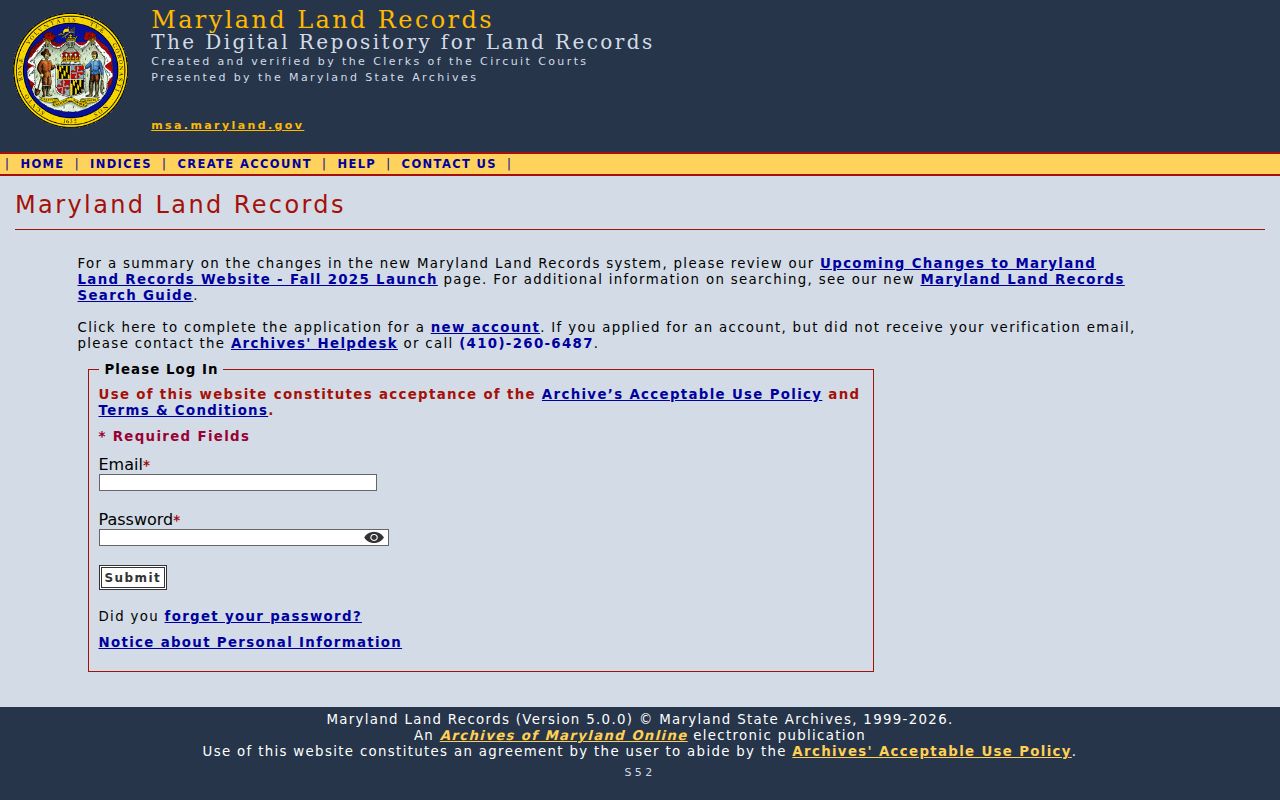
MDLandRec party results cover owner names from January 1, 1969 to the present. Registration is required. The party index is not an address search. Start from SDAT or GIS to get the current owner's exact name and a liber/folio reference.
Older owners require book and page work. Spelling variants, initials, company names, and a married name often force more than one party search. Try every version of the name.
Note: The 1969 online name-search boundary is not the beginning of Calvert County deeds; it marks a change in search method.
Use Calvert County CE13 for Earlier Owner Indexes
The Maryland State Archives CE13 series guide covers Calvert County land-record indexes from 1812 through 1958. It gives volume and index context for work beyond the modern name-search period. The county's 1882 record loss is noted there. Use it for earlier owner indexes.
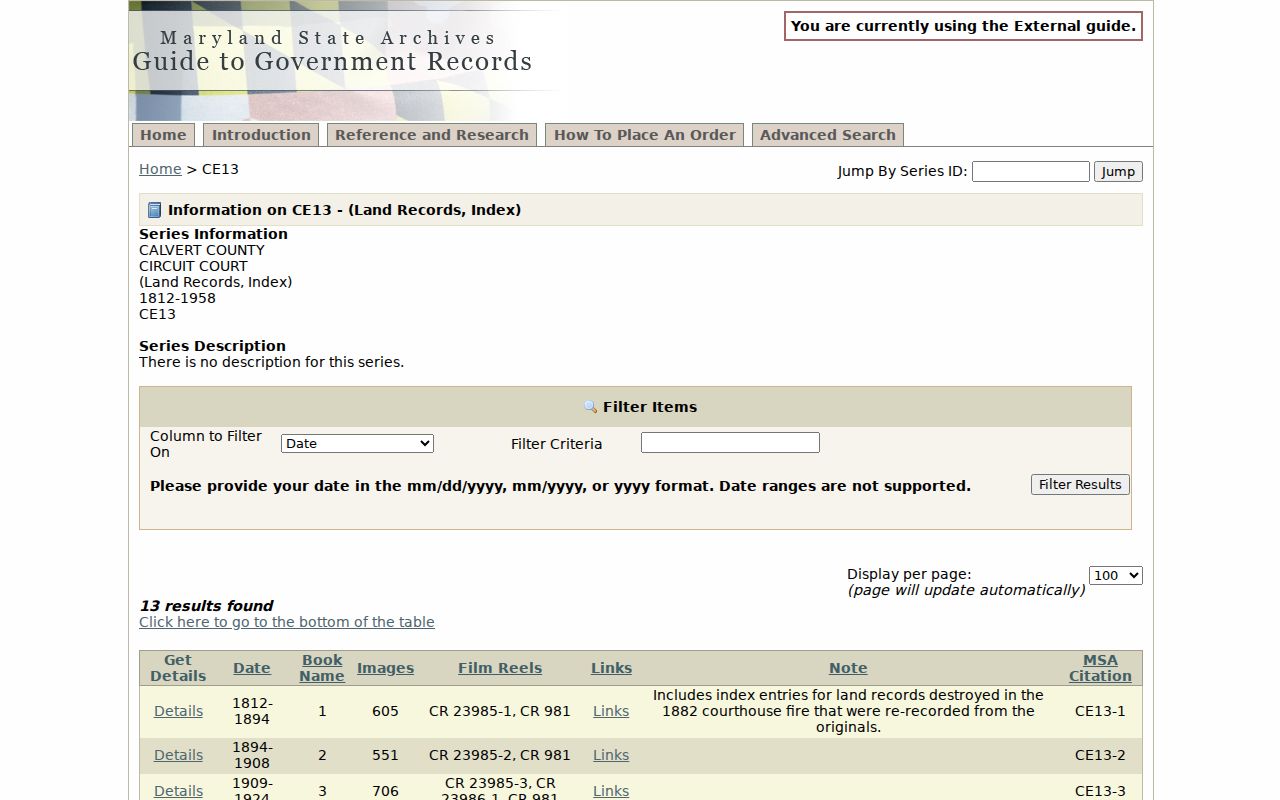
Record the index series, book, page, and spelling exactly. Then retrieve the surviving or re-recorded instrument and confirm its land description matches the chain.
Walk Calvert County's Chain of Title Backward
Reverse deed research follows a repeatable loop. The names change at every link. The land itself should stay traceable through its description, lot and block, account clues, or prior references.
- Find the current deed and read the present owner as grantee.
- Copy the grantor's exact name, recording date, legal description, and cited prior deed.
- Search that grantor as an earlier grantee, then verify the same land before adding the row.
- Repeat until the online search ends, then continue through the cited deed books, reverse indexes, and Archives series.
- Grantor and grantee
- The conveying party and receiving party named in an instrument.
- Chain of title
- The ordered series of recorded and supporting links for the same land.
- Reverse index
- An index organized to help find conveyances through the grantor side.
- Quitclaim and warranty deed
- Different deed forms whose legal effect should be read from the instrument, not guessed from a portal label.
A name list is not a legal conclusion. When the chain matters, a qualified Maryland title professional should examine liens, exceptions, probate authority, and competing interests.
Reconstruct Calvert County Owners Across the 1882 Fires
Fires in March and June 1882 destroyed most early Calvert County public records. An ownership chain may therefore jump from an early recital to a later re-recorded deed, abstract, or index entry. The gap reflects record history. It does not prove the land lacked an owner.
Work outward from the strongest surviving references. Deed recitals, land patents, probate papers, tax and assessment records, subdivision plats, and newspaper notices all help. A later instrument may quote the earlier parties and description even when the original book burned.
For this period, former owners are a reconstruction. Each previous owner needs a cited surviving source. Treat an uncertain prior owner as a lead until an independent record supports the link.
Find Former Calvert County Owners in Historic Assessments
Archives series C1509 holds historic assessments from 1917 through 1974. Rural records are arranged by district and alphabetical owner. Town and subdivision entries often run by block and lot. Today's street address alone can miss the path.
Twin Beaches labels add another wrinkle. The list includes Chesapeake Beach, North Chesapeake Beach, North Beach Town, North Beach Limits, Bay Crest, Middle, Talbott, Wickersham, Summer City, Avondale, and Barnards Point. Each may describe an assessment or subdivision grouping. Confirm each label against a current GIS map or town boundary.
Bridge Calvert County Probate and Heir Transfers
An owner's death breaks many chains. Calvert County estate records fill the gap. Probate accounts cover 1674 through 1777. Online estate material spans 1882 through 1912, and estate dockets from 1882 through 1979 sit in the search room. Estate papers from 1929 through 2014 come by request.
Look for the will, letters of administration, inventory, account, family settlement, order to sell, and the personal representative's deed, since death alone did not pass title to a particular heir. The successor deed and matched legal description complete the property link.
Note: A probate representative signed under estate authority; that role did not necessarily make the representative a former beneficial owner.
Read Calvert County Plats as Owner Clues
Plats carry real owner clues. Developers, subdivision names, block and lot numbers, and older road layouts all appear on them. The 1899 Chesapeake Beach Town Site plat and the 1926 Bay Crest resubdivision help resort-era work most, while North Beach research may need the 1908 North Chesapeake Beach plat plus later replats.
Find the image through Plats.net and Archives series C2237 or C2241, then return to the deed index with the names and book/page clues. A plat identifies the land. It cannot prove the whole ownership chain alone.
Know How Far Calvert County Ownership Records Reach
Calvert County property records reach back further than many owners expect. Electronic land records begin in 1851, and state index material reaches 1812. Older surviving documents sit in Archives collections. A patient researcher can still trace ownership deep into the nineteenth century. Fires in 1882 burned part of the record, though. No chain is guaranteed to run unbroken. A Calvert County ownership trail may end at a patent, an abstract, or a recital in another deed. It might also stop at a probate file, an old assessment, or a later re-recording rather than an intact original.
Lawful use. Research Calvert County former owners for house history, estate work, or property diligence. Never use the record trail to track, harass, threaten, or harm a living person.
Need a certified copy of a deed or the details of one instrument? The Calvert County deed records guidance walks through that. Keep every source date you find.
Treat uncertain links as leads, not proof. A full title opinion takes more than a parcel number and a hunch about the owner of record.